British Wildflower Motifs: A Pattern Designer's Guide to Native Species
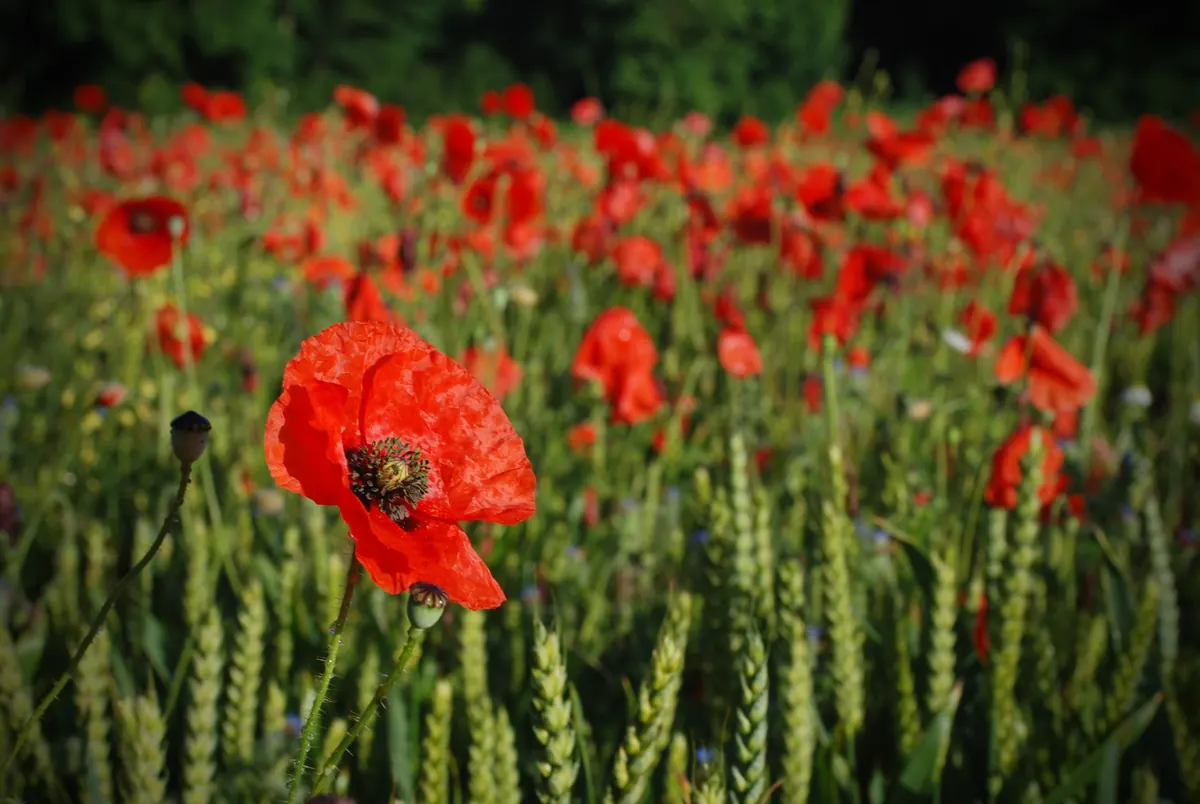
Walk a footpath in late May and the inspiration problem solves itself. Cow parsley sits at shoulder height, bluebells are retreating under the hedge, and a single poppy flares in a field margin. British wildflowers look modest up close and surprisingly strong in repeat. Clear silhouettes, generous colour, and shapes that distance has already simplified for you.
The trick is not to copy them literally. Find the two or three features that make a species instantly recognisable, exaggerate those, and drop everything else. A cornflower without its ragged edge is just a blue blob. A foxglove without its tapering spire is a stack of unrelated bells.
Why native species make reliable motifs
Most wildflowers have evolved to be seen and read at a distance, because their audience is insects rather than people. That means legibility is built in. A daisy head is a flat disc, a cow parsley flower is a dome, a foxglove is a vertical taper. Big, simple shapes survive reduction far better than intricate detail does, which is exactly what a repeat demands when a motif shrinks to a couple of centimetres.
They also carry recognition. Anyone who has walked a British lane in spring knows a bluebell's droop or a cowslip's nodding cluster, so a stylised version lands immediately. And because wildflowers grow in communities, they arrive with their own coordinate set: a hero bloom, a filler sprig, a texture of grasses and seed heads, and a background of mixed greens. One field visit can supply a whole collection.
Ten species worth drawing
Start with a handful rather than trying to cover everything. Each of these has a distinctive hook that holds up when you simplify it.
- Ox-eye daisy. White rays around a single yellow boss on a wiry stem. Keep the thin stalk and the slight asymmetry; drop the leaves.
- Cornflower. A blue so deep it reads purple in small print, with fringed outer florets. Reduce to a ragged-edged disc with a few spiky projections.
- Foxglove. A tapering spire of bells, mostly hanging to one side, with a spotted throat. Draw as an alternating stack, not a symmetrical cone.
- Field poppy. Four petals, brilliant scarlet, black centre. Offset the overlap so it looks like it has just opened.
- Cowslip. A cluster of small yellow bells nodding from the top of one stem, orange flecks at the throat. The cluster reads like a fringe.
- Bluebell. Bells arranged on one side of a drooping stem, tips curled back. The hanging curve is the giveaway, not the flower itself.
- Harebell. A single nodding bell on an almost impossibly fine stem. Emphasise the wire-thin stalk and the five pointed lobes.
- Yarrow. A flat-topped umbel of tiny cream or pink flowers above feathery leaves. Perfect as a filler between larger motifs.
- Teasel. A spiny oval head with a band of tiny lilac florets and bracts curving upward. Strong in silhouette, ideal for borders.
- Cow parsley. Lacy white umbels on hollow stems. Draw the flower heads as simple clusters and let the stems do the work.
Simplifying without losing the plant
Start with the silhouette
Fill the shape in solid black and look at it from across the room. If you can still name the plant, you have a motif. If not, the problem is proportion rather than detail: a harebell with a thick stem, or a poppy with a round head, loses its identity before you ever add colour.
Respect the petal count, roughly
Five petals for buttercups and campion, four for poppies, many for daisies and cornflowers. Exact numbers matter less than the rhythm they create, but wildflowers rarely look like neat geometric rosettes sitting flat in the centre of a tile. Tilt them. Let some face away.
Use seed heads as supporting cast
Poppy pods, teasel heads, honesty discs and grass spikes are quieter than flowers and far easier to repeat. They are what stops a wildflower pattern looking like a bouquet and starts it looking like a meadow.
If a motif isn't readable at eight millimetres, it's decoration rather than a motif.
Colour from the verge, not the photograph
Photographs lie. Screens exaggerate saturation, and shifting light changes the flower from one hour to the next. Work from memory and from a small painted swatch instead, mixed while you are still outside. Four or five colours is plenty for a wildflower repeat; more than that and the pattern turns muddy.
Group species by the places they grow and let each group carry its own palette. Chalk downland gives pale blue, cream, chalk white and grey-green. Cornfield margins give scarlet, deep blue and corn marigold yellow against dusty charcoal. Woodland gives bluebell violet, fresh green and anemone white. A wet meadow brings ragged robin pink, yellow flag and purple loosestrife. Blues and pinks tend to fight when they sit directly against each other, so separate them with a cream or a light green.
Building a repeat that prints
- Work small. Draw your first tile at roughly 15 to 20 centimetres square, the size it might actually print, rather than starting large and shrinking later.
- Draw elements, not a picture. One hero bloom, one stalk or sprig, one seed head, one grass mark. Keep each on its own layer or sheet.
- Choose a layout that suits the plant. Half-drop suits tall spires such as foxglove and loosestrife. A tossed or scattered arrangement suits nodding heads. An ogee works well for a more formal hedgerow look, and a simple stripe handles cow parsley and grasses neatly.
- Place by weight, not by grid. Spread the heaviest, most colourful blooms first, then fill the gaps with lighter elements. Scan the tile at thumbnail size and look for clumps and empty patches.
- Test at true scale. Print a section on paper, then check it at 8 to 10 millimetres for fabric, or 2 to 3 centimetres for a tea towel. Petals that vanish at the smaller size need thickening.
- Build a coordinate set. One hero print, one sprig or trellis, one texture of seeds and grasses, and one simple stripe. Four designs from the same drawings feel like a collection rather than four unrelated attempts.
Fieldwork, and a word on picking
Sketch and photograph in place. Many British wildflowers are legally protected, and even where picking is not prohibited it damages fragile sites; nature reserves and Sites of Special Scientific Interest have their own rules, so check before you take anything. If you want the plant in front of you for longer, grow it. Native seed is widely available, and a few pots of cornflower, poppy or ox-eye daisy on a windowsill will give you months of close observation without touching a hedgerow.
Take notes on structure while you are there: how many flowers sit on one stem, which way they face, how the leaves sit below the bloom. That information is what makes a simplified motif convincing later, when memory has blurred the details.
Finishing your first design
Pick one species, not five. Redraw it three times at different sizes, then reduce each drawing to two colours and a black line. Choose the version that still reads as the plant, build a small tile around it, and place a lighter filler behind it. Print it out and pin it somewhere you will see it by accident rather than on purpose, because the accidental glance tells you more about whether a motid holds up than a long, admiring stare.
Repeat the process with a second species from the same habitat, and you have the beginning of a collection rooted in a real place. That sense of place is what buyers and viewers respond to, and it is the thing that copying a generic floral bundle can never quite imitate.
Photo: Ian Kelsall / Pexels
How to Carve Rubber Stamps for Repeating Motifs on Fabric
Carve a simple rubber stamp, load it with fabric ink and print evenly spaced repeats onto cotton or linen...

Motif vs Pattern: What's the Difference in Surface Design?
A motif is a single self-contained shape; a pattern is what you get when repeats, layout, scale and colour...
About Us